
Internal Rate of Return (IRR) Calculator

IRR based on fixed cash flow
This calculator computes the IRR based on a fixed recurring cash flow or no cash flow.
IRR based on irregular cash flow
This calculator computes the IRR based on the initial investment and subsequent annual cash flows. If you want to calculate the IRR for cash flows that are not annual, please use our Average Return Calculator.
In investments and finance, decision-makers and analysts often face the challenge of comparing multiple project proposals or investment opportunities. Each project typically comes with a forecasted series of future cash flows, an upfront cost (or costs), and a certain degree of risk. To accurately judge the potential profitability of these endeavors, financial analysts employ various metrics. One popular and powerful metric for project evaluation is the Internal Rate of Return (IRR). Understanding IRR can be immensely helpful for anyone involved in capital budgeting, corporate finance, personal investing, or any scenario that requires evaluating the viability of cash-flow-generating projects.
What is the internal rate of return?
At its core, the internal rate of return is a discount rate at which the net present value (NPV) of a project's cash flows equals zero. When investors or businesses undertake a project, they typically pay an initial cost (the investment) and may make additional investments as well as receive a series of returns (cash inflows) over time. Because money today is worth more than the same amount of money in the future, future cash flows need to be adjusted (or "discounted") back to their present value. The internal rate of return is the specific discount rate that makes the project's net present value exactly zero.
In other words, IRR is the "break-even" rate of return for an investment when considering the time value of money. If the IRR of a project is higher than the company's required rate of return or the cost of capital, the project is generally considered worthwhile because it implies that the project will generate a return higher than its cost. Conversely, if the IRR is below the required rate of return, the project may not be viable, as it may not generate sufficient returns to justify the investment.
How is IRR calculated?
The formula for the internal rate of return is essentially the same as the net present value formula except that instead of calculating NPV for a given discount rate, we solve for the discount rate that sets NPV to zero. The net present value (NPV) equation for a series of cash flows can be written as,
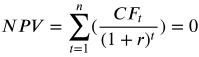
where:
- CFt is the cash flow over period t. (Note that CF0 is typically negative if it represents the initial investment).
- r is the discount rate, or in this context, the IRR.
- t is the time period (from 0 to n).
To find the IRR, we adjust r until the sum of the present values of all cash inflows and outflows equals zero. In practice, this cannot be solved by simple algebraic manipulation for most real-world projects. Instead, analysts typically use financial calculators (such as the one provided above), spreadsheet software, or specialized financial tools that iteratively find the rate at which NPV equals zero.
What is the use of IRR?
Ultimately, IRR helps translate complicated patterns of cash inflows and outflows into a single number that can be compared directly to alternatives or required benchmarks. Whether you are deciding whether to purchase new equipment, evaluating real estate deals, or considering a long-term business expansion, IRR can help bring clarity and structure to the evaluation process, enabling you to make more data-driven decisions. The following are some of the specific applications of IRR in finance and business.
1. Investment decision making
Businesses and investors use IRR to evaluate different investment opportunities. If an investment's IRR exceeds the company's required rate of return (hurdle rate), it is considered a good opportunity.
2. Capital budgeting
Companies use IRR to compare different projects and determine which ones will generate the highest returns. Projects with higher IRRs are often prioritized.
3. Loan and lease analysis
Lenders and financial analysts use IRR to assess the cost of financing options and lease agreements to ensure profitability.
4. Private equity and venture capital
IRR is commonly used in venture capital and private equity to measure return on investment over time. Higher IRR indicates better-performing investments.
5. Real estate investment analysis
Real estate investors use IRR to assess the profitability of properties by factoring in purchase price, rental income, maintenance costs, and potential sale price.
Example 1: A simple investment project
Let's say a small manufacturing firm is evaluating the purchase of a machine that costs $40,000 upfront. The machine is expected to generate the following cash inflows:
- End of Year 1: $10,000
- End of Year 2: $20,000
- End of Year 3: $30,000
To find the IRR using the "IRR based on irregular cash flow" calculator above enter $40,000 as the initial investment and $10,000, $20,000, and $30,000 in the year 1, 2, 3 fields, respectively, then click the "Calculate" button. The calculator should return an IRR of 19.438%. This indicates that the machine's purchase and the subsequent cash inflows yield an annualized return of 19.438% once we factor in the time value of money.
Now, if the firm's cost of capital is 12%, then a 19.438% IRR is comfortably above the hurdle rate, which suggests that the project is financially appealing. Conversely, if the firm's cost of capital were 20%, then the 19.438% IRR does not meet the required rate of return.
Example 2: Multiple projects
Imagine you have two potential real estate investments. Both require an initial outlay of $100,000. Over a five-year period, each will generate different cash inflows:
Investment A:
- End of Year 1: $5,000
- End of Year 2: $20,000
- End of Year 3: $25,000
- End of Year 4: $40,000
- End of Year 5: $60,000
Investment B:
- End of Year 1: $0
- End of Year 2: $10,000
- End of Year 3: $30,000
- End of Year 4: $30,000
- End of Year 5: $80,000
If you were to just sum the total cash flows, you might notice that each investment pays out a total of $150,000. Considering only simple ROI yields:
| ROI = | Total Cash Inflow - Initial OutlayInitial Outlay |
| = | $150,000 - $100,000$100,000 = 50% |
Thus, both investments have a 50% ROI, but they do not pay out evenly over the years. This difference in timing is crucial. When you factor in the time value of money using IRR, the one that pays earlier might actually have a higher IRR because receiving cash sooner allows for reinvestment or reduces the duration of investment risk. Plugging these individual yearly inflows into the "IRR based on irregular cash flow" calculator yields:
- IRR of Investment A: 11.290%
- IRR of Investment B: 10.259%
Despite both generating the same total returns over five years, Investment A appears more attractive on an annualized basis (11.290% vs. 10.259%). This is a classic example of why IRR provides more nuanced insight than basic ROI in many capital budgeting scenarios.
Limitations of IRR
While IRR is a powerful financial metric for evaluating investments and making business decisions, it isn't without its drawbacks:
- Scale of projects: IRR does not account for the overall scale of the project. A project with a smaller investment and a high IRR might generate a smaller total profit than a larger project with a slightly lower IRR.
- Risk of projects: IRR does not explicitly factor in the risk or uncertainty of the cash flows being analyzed. Instead, IRR focuses purely on the timing and magnitude of projected cash flows and assumes they will occur as forecasted. Often, a project with a lower IRR but relatively low uncertainty may be preferred over a project with a higher IRR with significant risk.
- Assumption of reinvestment rate: The IRR calculation implicitly assumes that interim cash flows are reinvested at the IRR itself. This assumption may not always be realistic.
- Multiple IRRs: In some cases (especially projects that have alternating signs of cash flows—e.g., negative, then positive, then negative again), the mathematical formula can yield more than one IRR. This can be confusing and reduces the straightforward interpretability of IRR in certain real-world situations.
That being said, IRR is not a one-size-fits-all metric. Other metrics like NPV, modified internal rate of return (MIRR), or payback period can provide supplemental perspectives. In practice, decision-makers and financial analysts typically look at multiple measures, including IRR, to arrive at the most informed decision.
The IRR Illusion: Why a 15% Return Might Be a Terrible Decision
An Internal Rate of Return (IRR) calculator doesn’t just measure profit; it judges the timing and scale of your cash flows against a hidden benchmark: your next best alternative. A project flashing a 15% IRR can be a trap if it locks your capital for a decade, while a 12% IRR opportunity that returns cash in three years might fund your next two investments. This guide moves beyond the formula to show you how to wield IRR as a strategic decision filter, not just a financial report card.
The High-Stakes Dilemma: Two Buildings, One Winner
Imagine you’re Elena, a seasoned real estate investor with $500,000 to deploy. You’re eyeing two commercial properties.
- Property A (“The Flip”): A distressed warehouse. Purchase and renovation cost: $500,000 upfront. Expected sale in Year 3 for $850,000, yielding a single, large cash inflow.
- Property B (“The Compound”): A small apartment complex. Purchase: $500,000 upfront. Generates net operating income of $40,000 annually for Years 1-5, and sells at the end of Year 5 for $600,000.
Running the numbers through an IRR calculator, Property A shows an IRR of approximately 19.3%. Property B shows an IRR of approximately 14.5%. The immediate, surface-level analysis screams “Choose Property A!” This is the first and most dangerous illusion of IRR. It treats all percentage returns as equal, regardless of when you get your money back or what you do with it.
The Critical Trade-Off Most Investors Miss: IRR assumes you can reinvest interim cash flows at the same rate of return. For Property B, the calculator assumes you can take that $40,000 annual income and reinvest it immediately at another 14.5%. In reality, finding another deal of that quality the moment cash hits your account is improbable. This “reinvestment rate assumption” is IRR’s built-in blind spot. Property A’s single exit avoids this problem but concentrates all your risk and opportunity cost into one future event.
Deconstructing the Math: What the Formula Actually Solves
The IRR is the discount rate that makes the Net Present Value (NPV)
of all cash flows from a project equal to zero. In equation form, it
solves for r in:
0 = CF₀ + CF₁/(1+r)¹ + CF₂/(1+r)² + ... + CFₙ/(1+r)ⁿ
Where CF is cash flow at time t (with
CF₀ being the initial investment, a negative number).
This isn’t a simple average. It’s the root of a polynomial equation, which is why calculators are essential. The strategic significance lies in what this “zero NPV” rate represents: your project’s intrinsic break-even cost of capital. If your actual cost of borrowing or your required rate of return (hurdle rate) is below the IRR, the project theoretically creates value. If it’s above, it destroys value.
The Hidden Variable: The “Hurdle Rate” is Personal. The IRR calculator gives you a project’s number. The decision hinges on comparing it to your number. A 14.5% IRR is spectacular if your next-best option is a 5% bond. It’s a disaster if you have a proven track record of finding 20%+ opportunities. The calculator doesn’t know your opportunity set; you must supply that context.
Sensitivity Analysis: Where Small Assumptions Break Big Promises
The IRR output is a point estimate, but reality is a range. Let’s stress-test Elena’s dilemma with a simple sensitivity analysis on Property B’s annual income.
| Scenario | Annual Cash Flow (Yrs 1-5) | Sale Price (Yr 5) | Calculated IRR | Verdict vs. Property A’s 19.3% |
|---|---|---|---|---|
| Best-Case | $45,000 | $620,000 | ~16.1% | Still lower, but cash flow improves liquidity. |
| Base-Case | $40,000 | $600,000 | ~14.5% | The original comparison. |
| Worst-Case | $35,000 | $580,000 | ~12.9% | The gap widens significantly. |
Now, analyze Property A’s sensitivity to a delayed sale.
| Scenario | Sale Delay | Sale Price | Effective IRR | The Real Cost of Time |
|---|---|---|---|---|
| On Schedule | Year 3 | $850,000 | ~19.3% | The advertised return. |
| 6-Month Delay | Year 3.5 | $850,000 | ~16.1% | A 3.2% IRR drop from a timing slip. |
| 12-Month Delay | Year 4 | $850,000 | ~13.8% | Now comparable to a performing Property B. |
This reveals the asymmetry. Property A’s IRR is exquisitely sensitive to timing. A single bad permit, market hiccup, or contractor delay vaporizes its advantage. Property B’s IRR, while lower, is more resilient, built on recurring cash flow that isn’t solely dependent on a future exit event. The “Silent Killer” here isn’t a bad project; it’s an optimistic timeline.
The Opportunity Cost You’re Not Calculating
Choosing Property A means your $500,000 is entirely illiquid for 3+ years. You cannot access it without selling the project, likely at a discount. During that time, what are you not doing?
- Missing Parallel Opportunities: You can’t use interim cash flows to invest in other deals. The $40,000 annual income from Property B could be used for a down payment on a third property in Year 2.
- Increased Risk Concentration: Your entire capital is bet on one asset class, one location, and one exit strategy. Property B provides some diversification of cash flow timing.
- Personal Liquidity Needs: If an emergency arises, Property B’s cash flow can service debt or cover costs without forcing a fire sale of the asset.
The IRR calculator cannot quantify this. It’s a mathematical function, not a strategic advisor. Your job is to map the IRR output against your personal balance sheet and future deal flow.
Actionable Checklist: From Calculation to Decision
Before you trust an IRR number, run through this list:
- Interrogate the Reinvestment Assumption. Ask: “What will I realistically do with the interim cash flows?” If the answer is “park it in a savings account,” the project’s effective return is lower than the IRR suggests. Consider using the Modified Internal Rate of Return (MIRR), which lets you specify a conservative reinvestment rate.
- Stress the Timeline. For projects with a single exit (like flips, developments, or venture capital), model a 25-50% longer holding period. If the IRR still clears your hurdle rate, the project has a margin of safety.
- Compare to Your Personal Benchmark. Your hurdle rate isn’t the S&P 500’s historical average. It’s the return of the next best specific alternative you would invest in with this capital. Be ruthlessly honest.
- Decouple the IRR from the Story. The most dangerous moment is when a compelling narrative (“This neighborhood is about to boom!”) inflates your confidence in the cash flow projections feeding the IRR. The math is only as good as the inputs.
Three Pro-Tips Beyond the Math
- Use IRR to Negotiate, Not Just to Decide. If a seller is pitching a 20% IRR, demand the cash flow projection. Plug it in. Then, adjust the exit price down by 10% and the timeline out by one year. Present this new, lower IRR. This forces a conversation about realistic risk, not just optimistic spreadsheets.
- The “IRR Payback Period” Hybrid. Calculate how many years it takes for the undiscounted cumulative cash flows to repay the initial investment. A project with a high IRR but a 7-year payback is a different beast than one with a slightly lower IRR and a 3-year payback. The latter frees up mental and financial capital sooner.
- Beware the “IRR Eraser” - Capital Calls. Some deals (like certain private equity funds) have provisions for future capital calls. A positive early IRR can be completely wiped out by a later cash demand. Your net invested capital increases, recomputing the IRR downward. Always model the full commitment, not just the initial check.
This is Direction, Not a Destination
An IRR calculator is a powerful lens for comparing the time-value of money across disparate opportunities. It translates complex cash flow streams into a single, comparable percentage. But its output is a starting point for deeper inquiry, not a finish line. It answers “what if the projections are right?” while your job is to ask “what happens when they’re wrong?”
For decisions involving significant capital, consult a fiduciary financial advisor or a CFP® professional who can integrate this calculation into your full financial picture, tax situation, and long-term goals.