
Stair Calculator
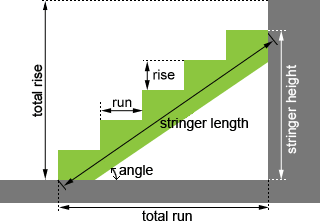
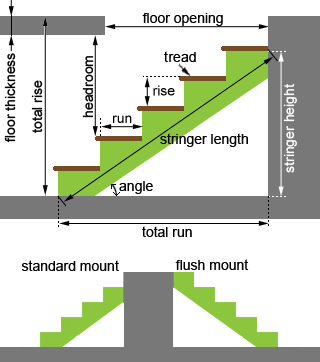
The Stair Calculator is an online tool for calculating various parameters involved in the construction of stairs. Refer to the figure adjacent to the calculator as a reference. A fraction to decimal conversion table for common fractions used in measurements is also provided at the bottom of the page.

Basic Version
Comprehensive Version
Engineering the Vertical Traverse: The Mathematics of Stair Calculation
A stair calculator translates a total vertical rise into a sequence of safe, code-compliant steps by enforcing the inverse proportional relationship between riser height ($R$) and tread depth ($T$). The primary objective is to solve for the integer number of risers ($n$) such that $R = \text{Total Rise} / n$ falls within acceptable limits, subsequently deriving $T$ using Blondel's Formula: $2R + T = C$, where $C$ is the target step circumference (typically 63 cm to 65 cm, or 24" to 25.5"). This tool exists because historical building failures—specifically the high incidence of ascending missteps on overly steep Victorian-era residential stairs—forced the standardization of spatial geometry to align with human biomechanical stride length.
The most prevalent misconception in stair construction is that local building codes dictate a single, rigid pair of dimensions for risers and treads. They do not. Codes establish boundaries. The International Building Code (IBC), for instance, permits residential risers up to 7.75 inches and minimum treads of 10 inches. Assuming a 7-inch riser is universally "correct" is a mathematical error. If you blindly force a 7-inch riser on a total rise of 98 inches, you get exactly 14 risers. But if your rise is 100 inches, forcing a 7-inch riser yields a non-integer (14.28), requiring you to round to 15 risers at 6.67 inches each. The code allows it. Human gait, however, exhibits high sensitivity to this variance. Studies on pedestrian fall data show that irregular step geometry—specifically deviations greater than 3/16 of an inch between consecutive risers—drastically increases trip probability because the brain recalibrates its proprioceptive feedback with each step. Uniformity matters more than hitting an exact target dimension.
The Biomechanical Constraint: Blondel's Formula
Before calculating, we must define the governing equation. In the 17th century, François Blondel observed that the energy expended to lift a foot vertically is roughly twice that of moving it horizontally on a flat plane. This yields the invariant:
$2R + T = C$
| Parameter | Symbol | Typical Residential Bound | Typical Commercial Bound |
|---|---|---|---|
| Total Rise | $H$ | Variable | Variable |
| Riser Height | $R$ | 6" – 7.75" | 4" – 7" |
| Tread Depth | $T$ | 10" – 11.5" | 11" – 14" |
| Stride Constant | $C$ | 24" – 25.5" | 24" – 25.5" |
| Headroom Clearance | $D$ | 6' 8" (min) | 6' 8" (min) |
Step-by-Step Computational Walkthrough
EX: Calculating a Straight-Run Stair
Assume a total vertical rise ($H$) of 102 inches, measured from finished lower floor to finished upper floor. We target a stride constant ($C$) of 25 inches.
Step 1: Solve for the integer number of risers ($n$).
Estimate initial $n$ using a target riser of 7 inches: $n = 102 / 7 = 14.57$.
We must select an integer. If $n = 14$, $R = 102 / 14 = 7.28$ inches. This is legal but steep.
If $n = 15$, $R = 102 / 15 = 6.8$ inches. This is highly comfortable. We select $n = 15$.
Step 2: Calculate exact tread depth ($T$).
Rearrange Blondel's Formula: $T = C - 2R$.
$T = 25 - 2(6.8) = 25 - 13.6 = 11.4$ inches.
Step 3: Calculate total horizontal run.
The number of treads is always $n - 1$ (the top riser terminates at the upper floor, requiring no upper tread).
$\text{Total Run} = 14 \times 11.4 = 159.6$ inches.
Step 4: Evaluate the architectural trade-off.
By choosing 15 risers, you gain biomechanical comfort (a 6.8" rise minimizes knee joint torque for average-height adults). You lose 11.4 inches of horizontal floor space compared to the 14-riser alternative. In a 10-foot wide room, a 159.6-inch run consumes significant square footage. If you choose the 14-riser layout, you gain 11.4 inches of floor space but lose ergonomic efficiency, increasing fall risk for elderly occupants. This asymmetry dictates that stair calculation is inherently an optimization problem, not a simple arithmetic one.
System Limitations and Edge Cases
This calculator operates under strict geometric assumptions that break down in specific architectural contexts. First, it is highly sensitive to measurement outliers. If the initial total rise measurement fails to account for future finishing materials (e.g., adding 3/4-inch hardwood over a subfloor), the bottom step will mathematically violate the uniformity constraint, creating a trip hazard. Always input the finished rise.
Second, the standard $2R + T = C$ model applies strictly to straight-run stairs. Winder stairs and spiral stairs require angular velocity calculations, where the inner walkline tread depth becomes the critical constraint, often rendering the outer tread depth irrelevant to safety. Using a standard stair calculator for a spiral staircase will yield compliant-looking numbers that result in an illegal, unsafe structure.
Downstream Decision Architecture
Once the rise and run are established, the calculation propagates into adjacent structural domains. The calculated total run determines the required length of the stair carriage (stringer), which dictates the span capability of the framing lumber—a 159.6-inch run requires engineered lumber or mid-span support, whereas standard 2x12 pine suffices for shorter runs. Furthermore, the total rise directly impacts the stairwell opening. A 102-inch rise requires a minimum opening length of roughly 120 inches to maintain the 6' 8" headroom clearance mandated by code, assuming a standard 38-degree slope. Users must immediately transition from this calculator to a stringer layout tool and a floor-framing span calculator to validate the physical feasibility of the mathematically optimal stair.