
Roofing Calculator
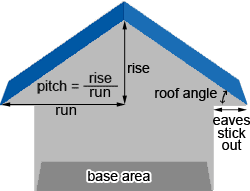
The following tools estimate the area of a roof, as well as the amount of materials necessary to construct a roof of a given area. The "House Base Area" is the area of land that the house covers, and for more complex shapes, it can be estimated using the Area Calculator.

Roofing Area Calculator
 |
Accurate Roofing Material Estimator: Calculate Area, Pitch & Material Requirements
A roofing calculator is a specialized engineering tool that translates two-dimensional building footprint measurements into three-dimensional surface area calculations, accounting for roof pitch (slope), and subsequently estimates material quantities, weight loads, and project costs. Its core function is to mitigate material waste and structural risk by applying geometric and industry-standard conversion factors.
Technical Definition: The Geometry of Roof Planes
A roof's surface area is not its footprint. The calculator's primary function is to convert the horizontal projected area (length x width) into the actual sloped area using the roof pitch. Pitch is defined as the vertical rise over a 12-inch horizontal run (e.g., a 6:12 pitch rises 6 inches for every 12 inches of horizontal distance). The mathematical relationship uses the Pythagorean theorem to find the hypotenuse (rafter length) of a right triangle formed by the rise and run. This "rafter length per foot of run" is the fundamental multiplier.
Formula & Methodology
The calculation follows a sequential methodology:
1. Roof Pitch Factor (RPF): Determines the slope multiplier.
Formula: RPF = √(rise² + 12²) / 12
For a 6:12 pitch: RPF = √(6² + 12²) / 12 = √(36 + 144) / 12 = √180 / 12 ≈ 1.1180
2. True Roof Area:
Formula: True Area = (Building Length + 2 x Overhang) x (Building Width + 2 x Overhang) x RPF
3. Material Quantities: Requires adding a waste factor for cuts, hips, and valleys.
Formula: Material Required = True Area x (1 + Waste Factor)
Industry Standard Constants & Data Table
| Roof Pitch | Rise:Run | Pitch Factor (RPF) | Waste Factor (Standard) | Common Application |
|---|---|---|---|---|
| Flat / Low Slope | 0:12 to 2:12 | 1.000 - 1.014 | 5-8% | Commercial, Membrane Roofing |
| Conventional | 3:12 to 9:12 | 1.031 - 1.250 | 10-15% | Residential Asphalt Shingles |
| Steep | 10:12 to 12:12 | 1.302 - 1.414 | 15-20% | Residential, Slate, Tile |
| Very Steep | >12:12 | >1.414 | 20%+ | Architectural, Specialty |
Additional Constants:
- Standard Shingle Bundle Coverage: ~33.3 sq ft (1/3 of a 100 sq ft "square").
- Average Asphalt Shingle Weight: 2.5 - 4.0 lbs/sq ft.
- Plywood/OSB Sheathing: 4 ft x 8 ft sheet = 32 sq ft.
Operational Context: Step-by-Step Calculation Example
Scenario: A residential gable roof, building dimensions 40 ft (L) x 30 ft (W), with a 6:12 pitch and a 1.5 ft overhang on all sides. Target material: asphalt shingles.
Step 1: Determine Adjusted Footprint.
Adjusted Length = 40 ft + (2 x 1.5 ft) = 43 ft
Adjusted Width = 30 ft + (2 x 1.5 ft) = 33 ft
Footprint Area = 43 ft x 33 ft = 1,419 sq ft
Step 2: Apply Pitch Factor.
From table, RPF for 6:12 ≈ 1.1180.
True Roof Area = 1,419 sq ft x 1.1180 = 1,586 sq ft.
Step 3: Calculate Material with Waste.
Assume 10% waste for a standard gable roof.
Total Material Required = 1,586 sq ft x 1.10 = 1,745 sq ft.
Convert to "Squares" (100 sq ft units): 1,745 / 100 = 17.45 squares.
Calculate Bundles: 17.45 squares x 3 bundles/square = 53 bundles.
Step 4: Estimate Sheathing.
Sheathing Sheets = 1,586 sq ft / 32 sq ft per sheet = ~50 sheets.
Technical Limitations & Environmental Factors
This estimation model contains inherent margins of error (typically ±5-15%) due to unmodeled variables:
- Complex Geometry: Calculations assume simple rectangular planes. Hip roofs, dormers, valleys, and turrets significantly increase waste (up to 25%) and complexity.
- Material-Specific Overhangs: Starter strips, ridge caps, and drip edges are linear measurements not captured by area calculations.
- Environmental Load: The calculator does not compute dead load (material weight) vs. live load (snow, wind, maintenance) for structural compliance. This requires separate engineering analysis per local building codes (e.g., ASCE 7).
- Thermal & Moisture Factors: Underlayment, ice & water shield, and ventilation requirements are independent of area calculations but critical to system performance.
Safety & E-E-A-T Disclaimer
For Estimation Purposes Only. This tool provides preliminary material quantity estimates. It is not a substitute for a detailed takeoff by a qualified roofing contractor or structural engineer. Actual requirements depend on precise field measurements, local building codes, manufacturer installation specifications, and an assessment of the existing roof deck and structure. All roofing work involves significant fall hazards and must comply with OSHA safety standards (29 CFR 1926 Subpart M). Professional verification is mandatory before procurement or construction.